Research

Robotics, reinforcement learning, control, and biomedical engineering.

Sequent: SOP-Driven, Physics-Verified Loco-Manipulation on a Simulated Humanoid

Human Centered Robotics Lab, UT Austin · Sep 2025 – Jan 2026
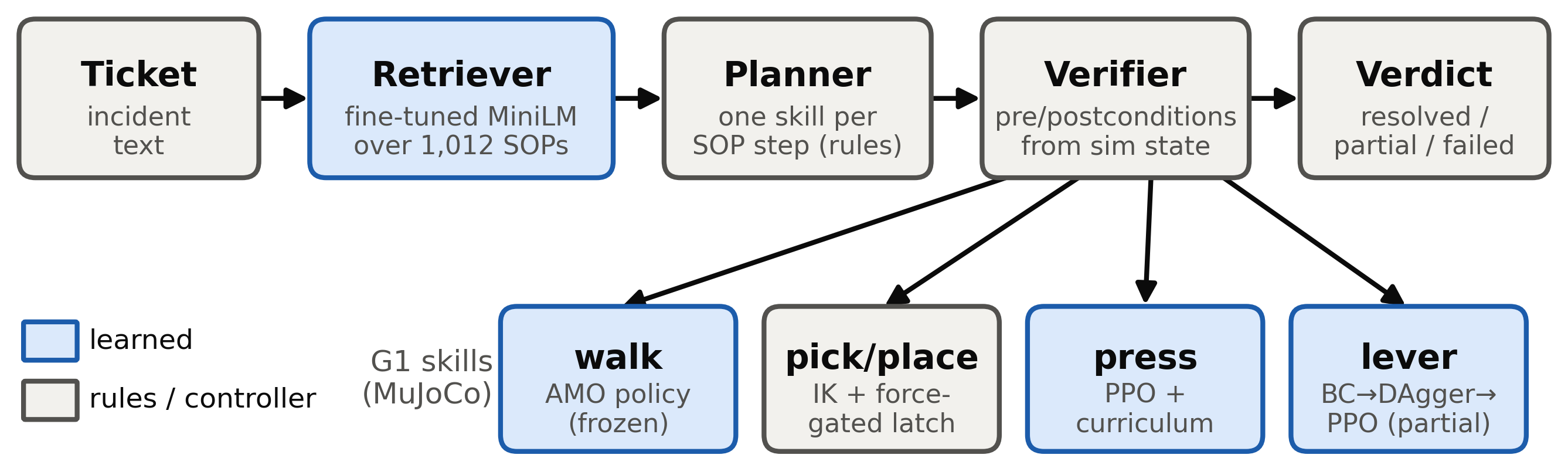
Sequent pipeline: ticket, retriever, planner, skills, verifier

A simulated Unitree G1 takes a plant-floor ticket, retrieves the matching procedure out of 1,012, maps its steps to skills, and checks each step from simulator state. The fine-tuned retriever reaches R@1 0.58 on held-out tickets (BM25 0.36). Videos and results are on the Projects page.

Retrieval Humanoids Reinforcement Learning MuJoCo

AI/ML + Controls Framework for Robotics

Intelligent Controls Lab, NC State University · Aug 2023 – Oct 2024, Summer 2025

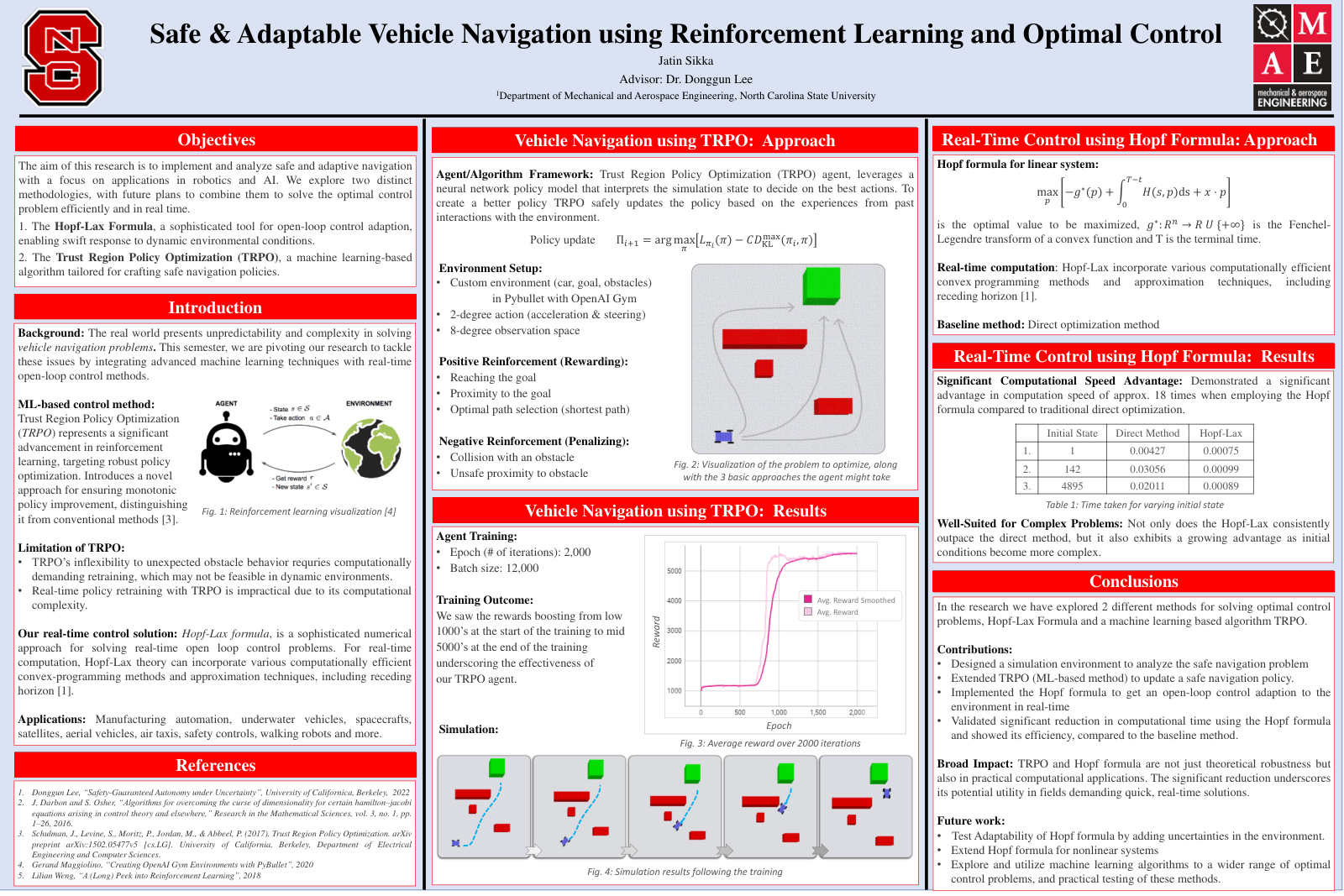
Research poster: Safe and Adaptable Vehicle Navigation using Reinforcement Learning and Optimal Control
Research poster (REU, NC State) · click to view full

Reinforcement learning combined with optimal control for autonomous systems, aimed at safe, reliable behavior.

Key work includes Safe Autonomous Vehicle Navigation using Reinforcement Learning and Optimal Control: navigation policies that combine RL exploration with control-theoretic safety constraints.

Reinforcement Learning Optimal Control Autonomous Navigation Safety Constraints

Development and Testing of Lung Phantoms

Biomedical Engineering Research · Fall 2023

Designed and tested physical lung phantoms for calibrating medical imaging, so imaging methods can be benchmarked without patient data.

Work covered material characterization, fabricating multi-layer tissue-mimicking structures, and testing against imaging standards.

Biomedical Engineering Medical Imaging Tissue Phantoms Materials Testing

Remote Strain Sensing for Ultra-High Temperatures

NC State University · MAE 534 Mechatronics class project, with Gabriel Chenevert · Spring 2024

Strain targets (copper traces on Nextel 440 ceramic-fiber mats) read remotely with RF instead of a bonded gauge. Simulated in Ansys HFSS, then measured with a vector network analyzer: under strain the absorption peak moved from 30.25 to 30.5 GHz in S11, and heating the target to about 200 °C left the response unchanged. The platinum target for higher temperatures was designed but not tested.

RF Sensing Ansys HFSS Strain Measurement High Temperature